
The same software subscription can be bought by a Kazakhstan individual for personal use or by a company for its team. That changes the VAT analysis. A “B2C” or “B2B” flag in billing does not establish the legal buyer. This guide gives a four-scenario review for a foreign supplier and the Kazakhstan buyer's finance team under the 2026 Tax Code.
Identify the legal buyer and seller first
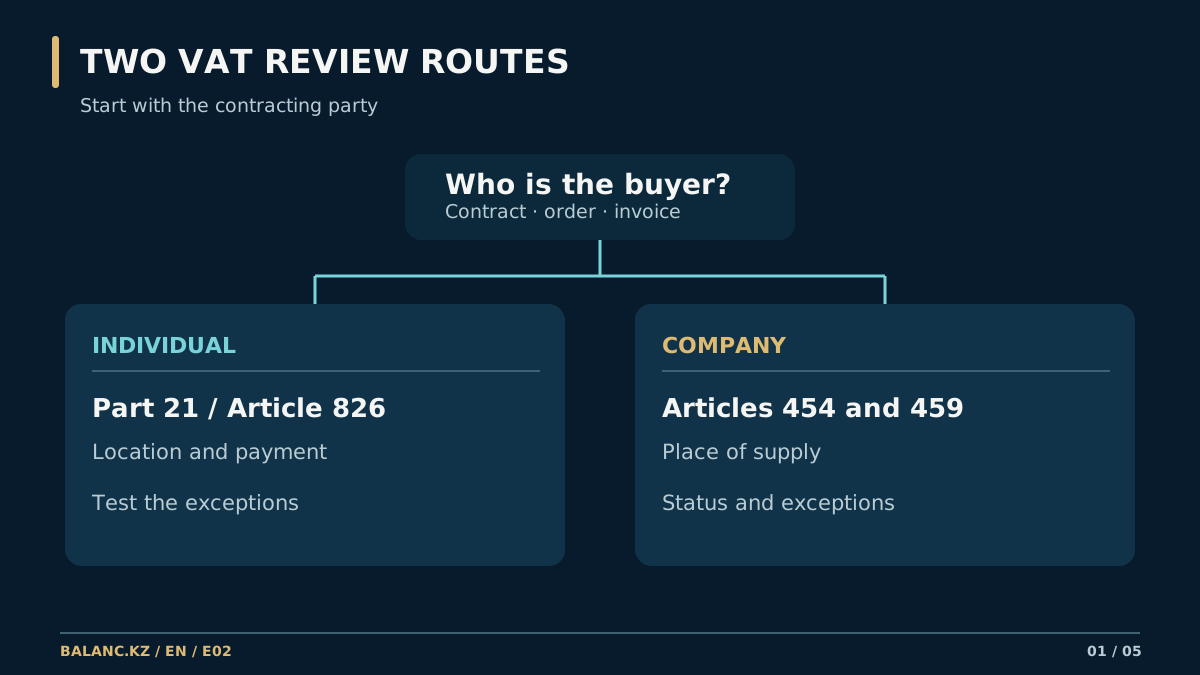
Part 21 of Kazakhstan's Tax Code covers a foreign company's electronic trade in goods and electronically supplied services to individuals. Under Article 826(1)–(2), a foreign company registered under Article 102 calculates VAT under that Part when at least one specified link between the individual buyer and Kazakhstan is present. A billing-country field alone cannot settle location: the Code lists residence, the account bank or electronic money operator, a network address, and a telephone country code.
A corporate purchase follows a separate review. If the Kazakhstan buyer is a VAT payer and the place of supply of services is Kazakhstan, Article 454(1) may treat its purchase of nonresident services as a taxable acquisition, subject to Article 454(3). Article 459 addresses the place of supply, including certain software-use rights and access to internet resources; Article 459(6) excludes Part 21 cases. B2B therefore cannot be coded automatically as “0% VAT” or “exempt”.
Four scenarios for one subscription
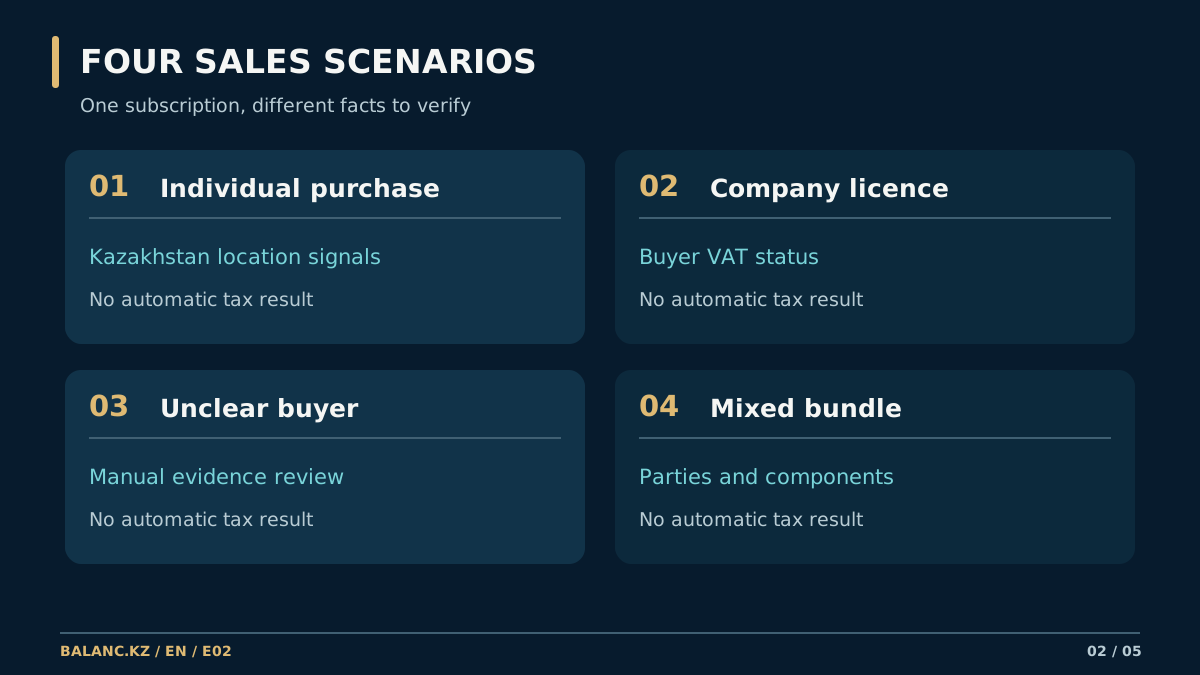
1. Personal subscription. Fictional foreign supplier ABC Corp sells access directly to an individual. If the supply qualifies as an electronic service and a location signal under Article 826(2) exists, review the foreign company regime: Article 102 registration, Article 827 calculation and Article 826(4) exceptions. No tax amount follows until the contract, price, payment date and seller status are known.
2. Licence for a Kazakhstan company's team. The contract and invoice name the company. Review what rights or services are supplied, place of supply under Article 459, whether the buyer is registered for VAT, and both Article 454(1) and its paragraph 3 exceptions. Whether input VAT can be credited is a separate issue outside this guide.
3. Unclear buyer. An employee enters a work email, pays with a personal card and adds the employer's name to a profile field. These signals conflict. Obtain the contracting party, invoice, order confirmation, purchase authority and payment trail. Route the transaction to manual review instead of automatically marking it “B2B, no VAT”.
4. Mixed bundle. One order covers company seats and an employee's individual subscription. Establish the contracting parties, what each component supplies, and any contractual price allocation. If the bundle is genuinely indivisible, it needs its own legal classification. An arbitrary billing split cannot create two separate contracts.
Evidence that establishes buyer status
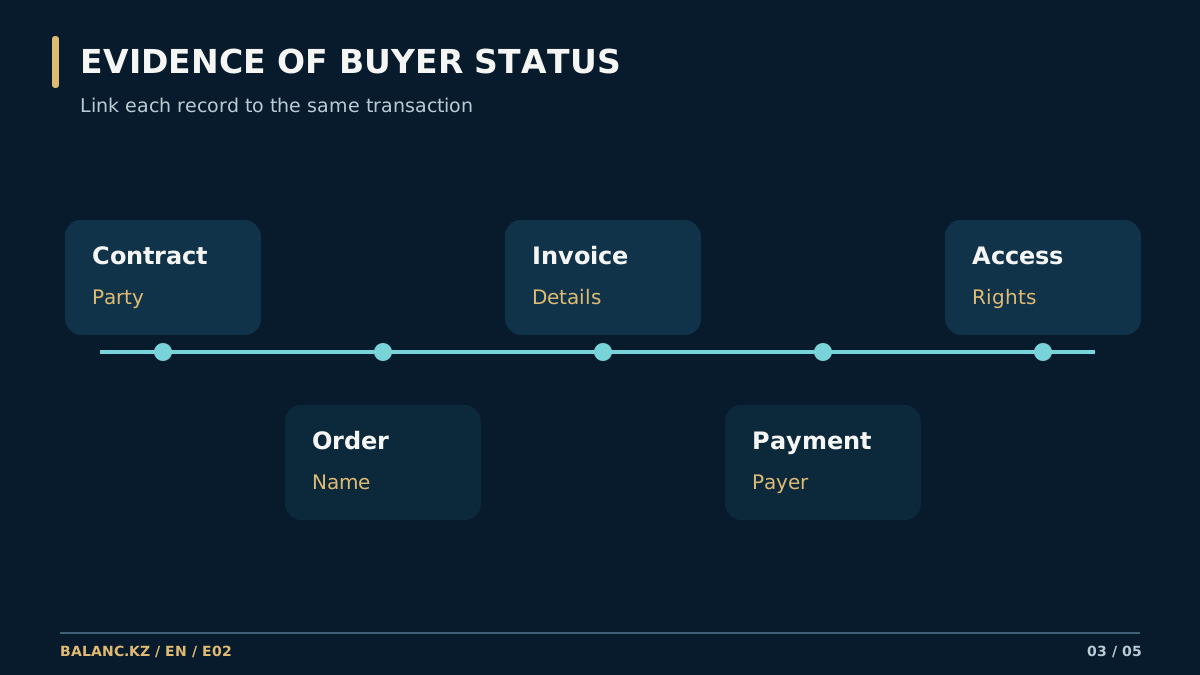
Compare the contract or terms, purchaser named on the order, invoice details, payer information and product-use records. A company identifier and business contract support a corporate classification, but a work email alone does not. An employee's personal card also does not rule out a purchase for the employer. Record who obtains the contractual rights and who assumes the obligations.
For a consumer sale, retain the original Article 826(2) location signals and the customer's payment timestamp. For a corporate sale, preserve the buyer's VAT registration status and the actual type of service. A marketplace or payment processor can handle cash without being the legal seller: check the platform contract, checkout, order confirmation and platform statement.
Mixed subscription: how to handle an exception
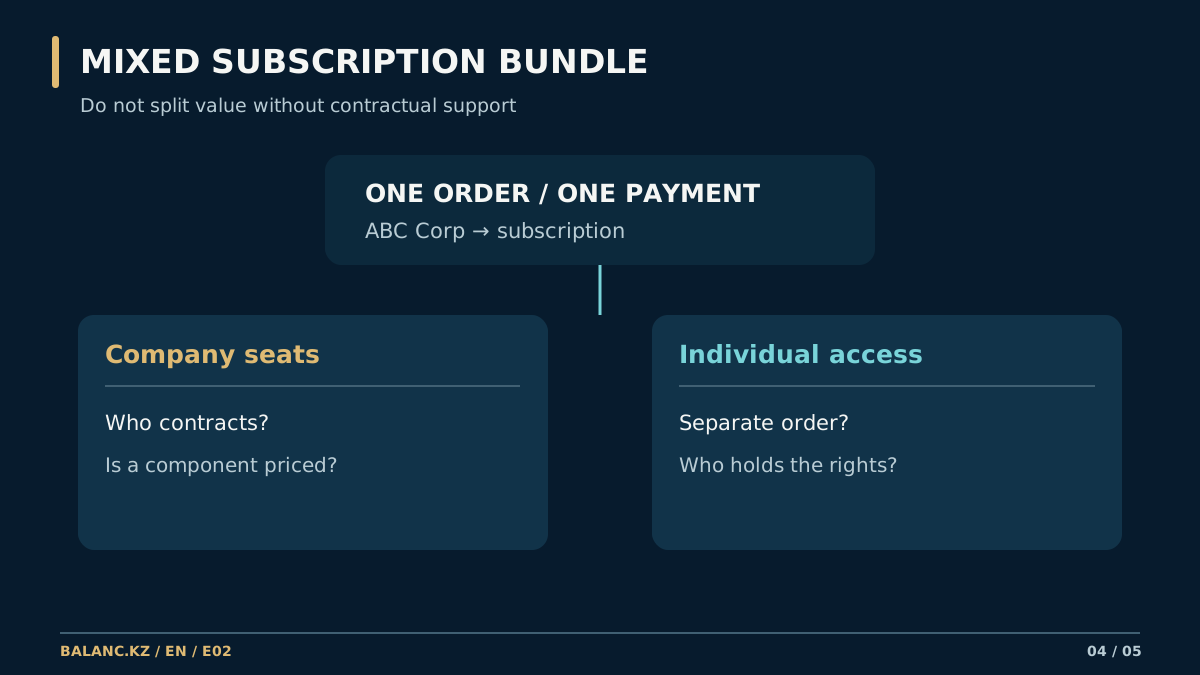
Suppose ABC Corp receives one payment for ten company seats and a manager's personal access. First determine whether there is one company contract or two distinct purchases by different customers. Then review the rights, price and refund terms for each component. Without a separate personal order, the word “personal” in the interface does not turn part of the company's contract into a consumer sale. Conversely, a shared payment account does not merge separate customer contracts.
Keep a written classification for each supply and list missing data. If the price and contracting party cannot be separated on the evidence, do not invent an allocation simply to close the period. For historical transactions preserve the terms version and law applicable on the transaction date.
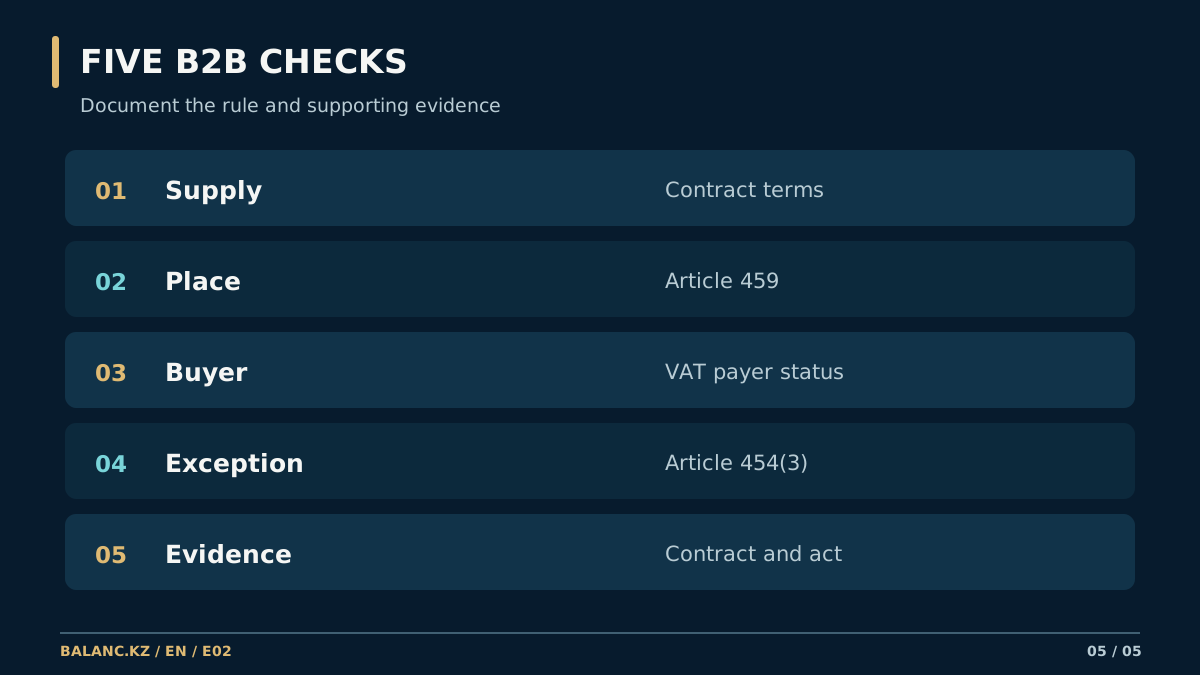
Five checks for a corporate licence
- Supply. Describe the use rights, access, support and related components. Classification follows the actual contract.
- Place of supply. Test Article 459, particularly Article 459(2)(4) for the listed software rights, access and services, and paragraph 5 where more than one place-of-supply rule might fit.
- Buyer. Confirm Kazakhstan registration and VAT payer status at the relevant time. Article 454(1) expressly addresses an acquisition by a VAT payer; do not extend that conclusion automatically to another buyer.
- Exceptions. Test Article 454(3). Its subparagraph 6 excludes the acquisition where the electronic service price includes VAT paid by the foreign company under Part 21 and the VAT amount is separately shown in an act or other document confirming the service. A bare “VAT included” label does not establish these conditions.
- Evidence and calculation. Match contract, invoice, service confirmation or other document, payment and tax status. The wider rules for acquiring nonresident services belong in the separate E13 guide; do not import the consumer payment timetable in Article 827.
The working output is a transaction register recording the legal buyer, classification, supporting evidence and exception owner. BALANC.KZ's existing guide to nonresident services and withholding tax covers a separate tax question. For the individual-customer route, see the Digital VAT overview.
Frequently asked questions
Is a company identifier in a form sufficient for B2B?
No. Check the contracting party, order and invoice. A freely entered identifier does not establish who acquired the rights.
Does Article 827 govern a corporate subscription?
Article 827 concerns the foreign company's supplies to individuals under Part 21. A corporate acquisition calls for a separate Article 454 and 459 analysis where their conditions apply.
Who accounts for VAT on a B2B purchase?
Article 454(1) addresses a Kazakhstan VAT payer acquiring nonresident services whose place of supply is Kazakhstan, subject to paragraph 3 exceptions. Verify those conditions for the transaction rather than deciding from the B2B label.
Does a work email prove that the company is the buyer?
No. It is a contact channel; the contractual customer and actual acquisition require documentary support.
What if the foreign supplier has already included VAT?
Check whether Part 21 applies, whether the foreign company paid VAT, and whether the amount is separately shown in the service act or other confirming document as Article 454(3)(6) requires. Do not assume an exception from a price label.
Can one rule cover an entire mixed bundle?
Only after identifying the parties and supplies. Account for genuinely separate contracts separately and document a specific position for an indivisible bundle.
Official sources
- Kazakhstan Tax Code No. 214‑VIII of 18 July 2025, version amended 1 July 2026: Articles 102, 454, 459, 826, 827 and 848.
- Full Tax Code text on the official Adilet legal system, Parts 7 and 21.
- State Revenue Committee: changes to VAT registration from 2026.