
A customer’s profile country is not the only Kazakhstan VAT location test for a foreign digital supplier. Article 826 of the Tax Code lists four independent signals for an individual customer. This guide explains what to inspect at checkout and how to document a transaction-level decision.
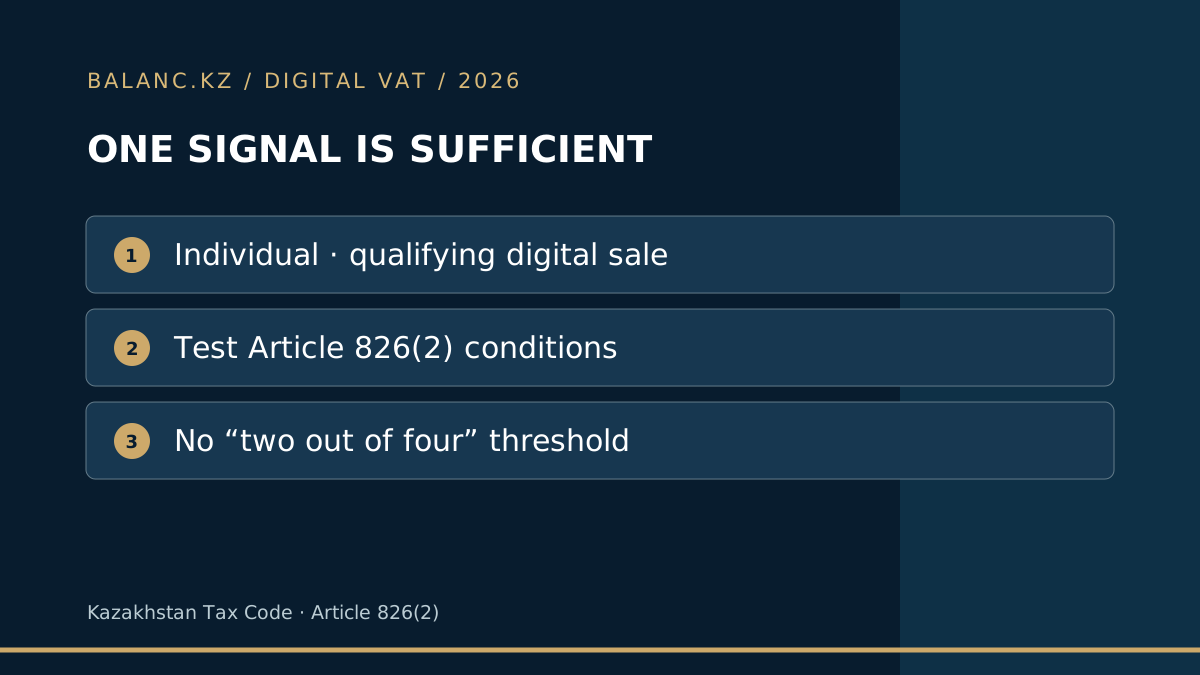
One qualifying signal, not a majority vote
Article 826(2) addresses electronic sales of goods and electronically supplied services by a foreign company to individuals. Its conditions are alternative: one qualifying signal is sufficient. A two-out-of-four rule is therefore unsupported. First establish the contractual seller, the buyer’s legal status and the nature of the supply. Do not apply this consumer test automatically to a corporate licence. Article 102 governs the foreign company’s registration; a location signal alone does not complete that separate analysis.
A practical sequence is to isolate individual sales, classify the electronic supply and only then test the four conditions. Traffic analytics can prompt a review but cannot replace evidence. Identify the platform’s contractual role too: handling the payment does not establish who sold the service.
What each statutory signal actually says
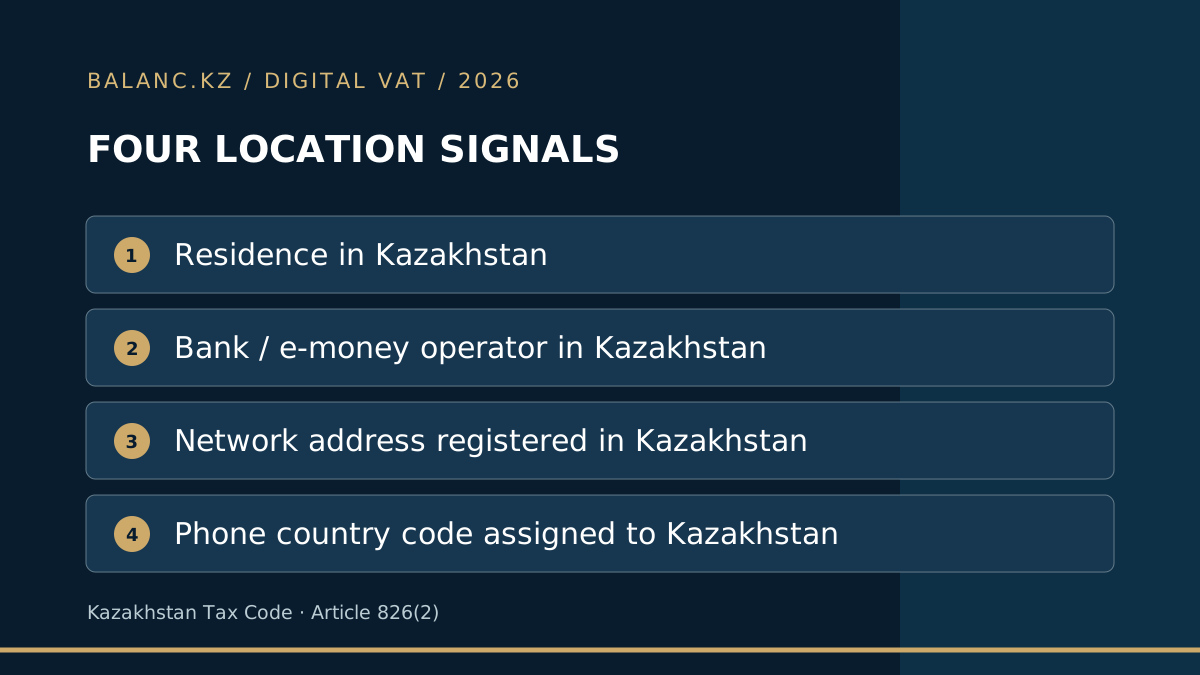
The first is the individual buyer’s place of residence in Kazakhstan. The second is the location in Kazakhstan of the bank holding the account the buyer uses to pay for services, or of the electronic money operator used for that payment. The third is the buyer’s network address used to acquire the services, registered in Kazakhstan. The fourth is an international country calling code assigned to Kazakhstan for the phone number used to acquire or pay for the services. Citizenship, interface language, billing currency and email domain do not substitute for these listed tests. Do not equate the location of a bank with a convenient card or interface label without checking the underlying payment facts.
For residence, record whether the address came from a declaration, profile or contract. For payment, determine the bank holding the account actually used or the electronic money operator. For the network address, retain the value at purchase, capture time and location method; a later login is a different event. For the phone, verify the numbering range used at acquisition or payment. These are evidence checks rather than new statutory conditions.
Example: a Kazakhstan bank and a foreign IP address
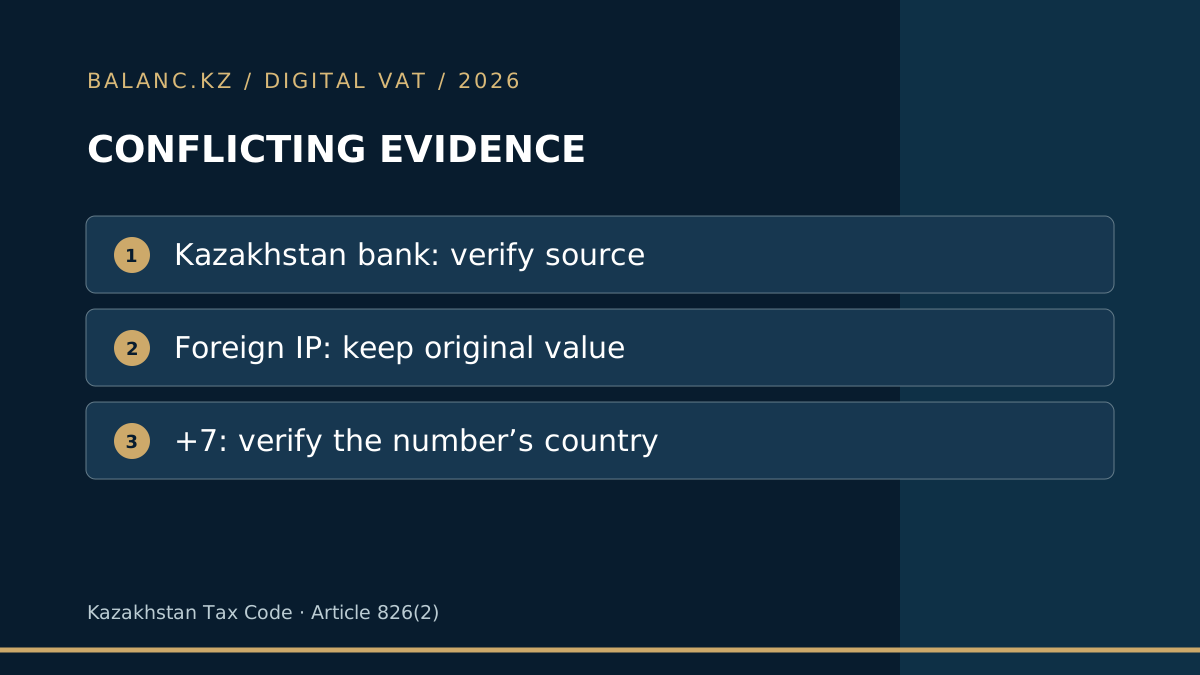
Fictional ABC Corp sells a subscription to an individual. The checkout records a +7 number and payment through a bank in Kazakhstan; the network address appears foreign. One substantiated Article 826(2) signal suffices for the Kazakhstan connection under this special regime. Yet +7 is shared by more than one country, so the bare prefix does not prove that the number’s country code is assigned to Kazakhstan. Preserve reliable bank or operator evidence and the original network address. Document conflicts instead of overwriting one field with another.
Reliable payment data locating the relevant bank in Kazakhstan is not negated by a foreign IP. If the alleged Kazakhstan bank was merely inferred from a card label, revisit the conclusion. Avoid giving a buyer a permanent country status across all orders: payment instruments and phone numbers change. Record the basis for each purchase.
Keep a defensible record with limited personal data
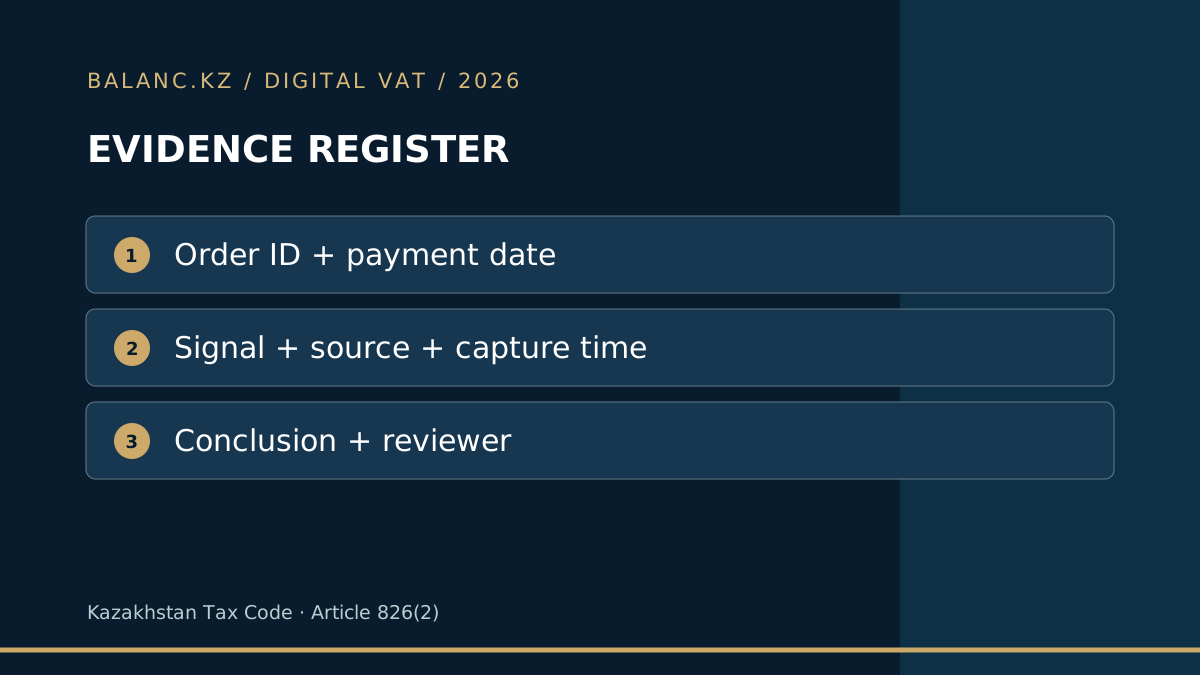
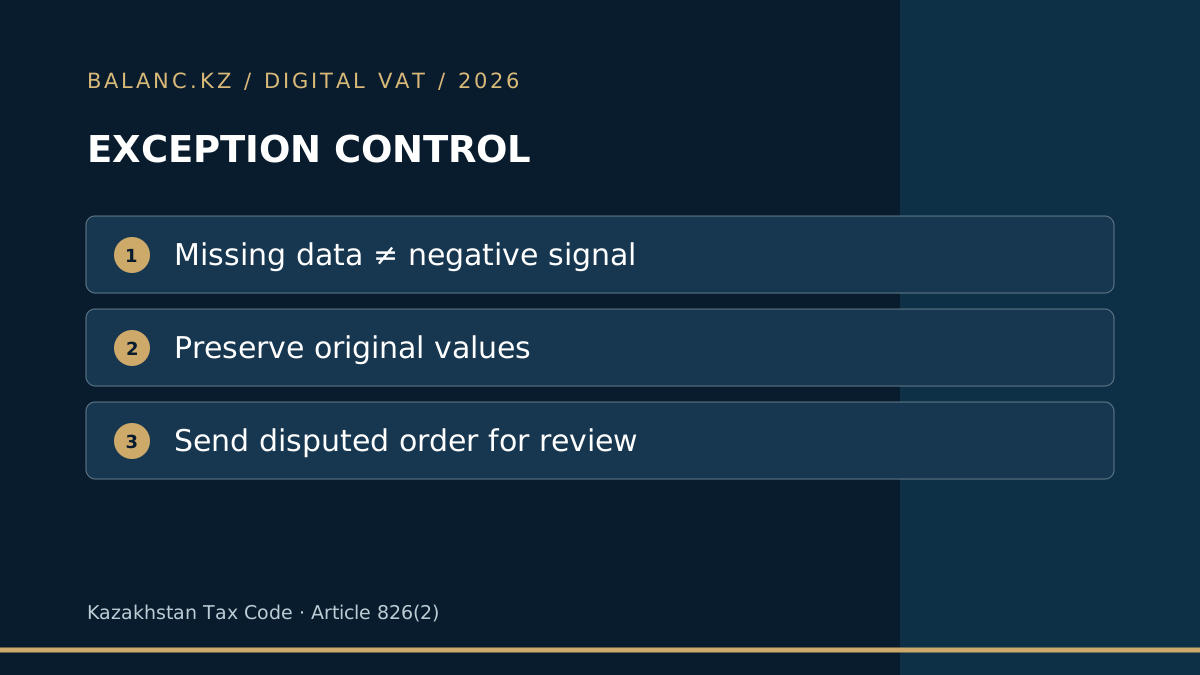
Connect the order ID, contractual buyer, payment date and value, each available signal, its source and capture time, and the reviewer’s conclusion. Record which evidence supports the conclusion and which information is unavailable. Restrict access to personal data and retain only what is needed for a justified tax decision under applicable privacy requirements. If a payment intermediary does not provide bank-location data, record the gap and seek appropriate evidence. Missing data is not a negative signal. A later trip or change of phone does not automatically rewrite the facts at purchase.
Separate observed value, source, legal assessment and supporting record in the register. This exposes a profile country with no underlying network address. For repeat orders, detect changes to payment instruments, phone numbers and addresses. Preserve manual corrections and original events instead of overwriting them with a final country flag.
Practical answers
Foreign IP with a Kazakhstan bank: examine the bank signal; there is no majority test. Bare +7 prefix: verify whether the number belongs to Kazakhstan. Company buyer: establish the contractual buyer and assess the business VAT route separately. Missing bank field: document the gap rather than ruling out Kazakhstan. Conflicting signals: preserve their values, sources and a reasoned conclusion; a separate guide covers the exception workflow.
When residence and bank information conflict, assess the reliability of each source. Matching opaque labels do not turn into proof. A missing Kazakhstan IP does not mean the other signals are absent. Seek permissible evidence and keep disputed transactions under manual review until a reasoned decision is recorded.
Sources
- Kazakhstan Tax Code No. 214-VIII, Article 826(2); version amended 1 July 2026 (Russian official text).
- Government Resolution No. 975 of 17 November 2025 — agreement on the shared +7 numbering zone (Russian text).
Reviewed 16 October 2026. The example is fictional; real transactions require their own documents.