
A foreign supplier receives its first payment for a digital service from a Kazakhstan customer. When must it file, which documents require notarisation, and what happens before its BIN appears in the public register? This guide follows Article 102 of the Tax Code and Finance Ministry Order No. 636, effective in 2026.
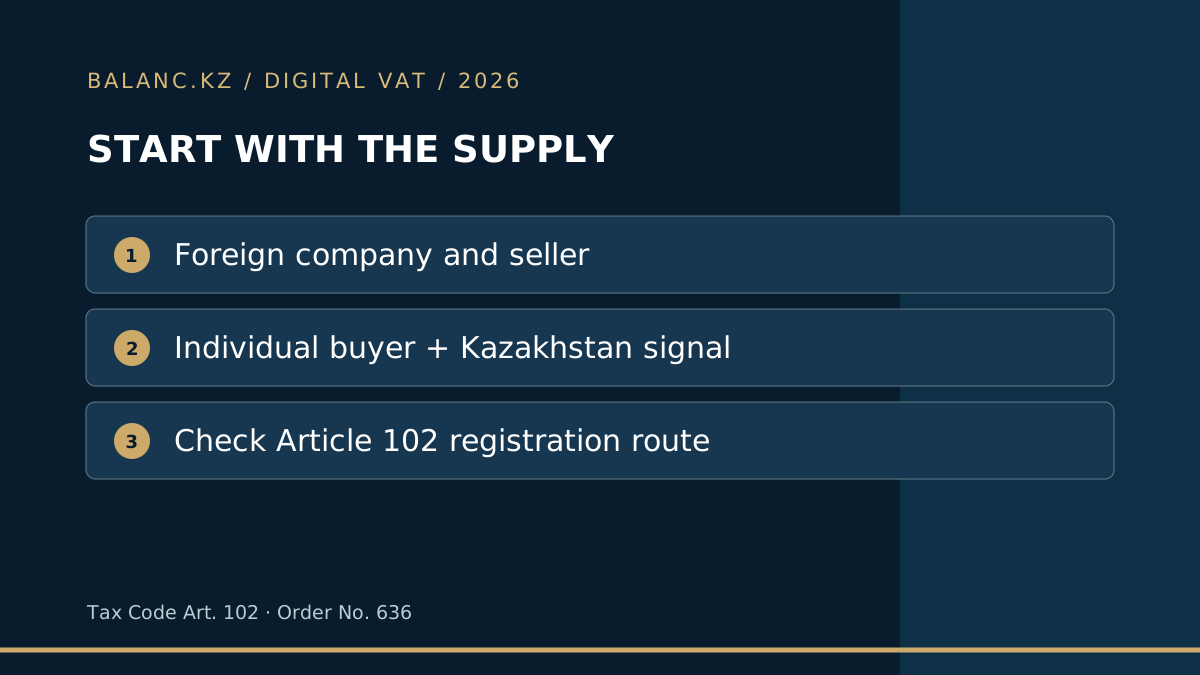
First establish the supply and foreign company
Conditional registration concerns a foreign company operating through an online platform in Kazakhstan. Article 826(1) identifies a company registered under Article 102 as the taxpayer under the special regime and excludes a person registered for VAT under Articles 100 or 101. For a consumer digital supply, determine the contractual seller, whether the supply qualifies, and at least one Kazakhstan customer signal under Article 826(2). A Kazakhstan website visitor is not enough on its own. If a marketplace sells in its own name, analyse the actual contractual chain separately.
Do not apply this consumer workflow automatically to a B2B sale. Establish the legal buyer and consider the separate place-of-supply and non-resident service rules. A supplier may use several platforms and payment channels; the data in its letter should reflect the actual model.
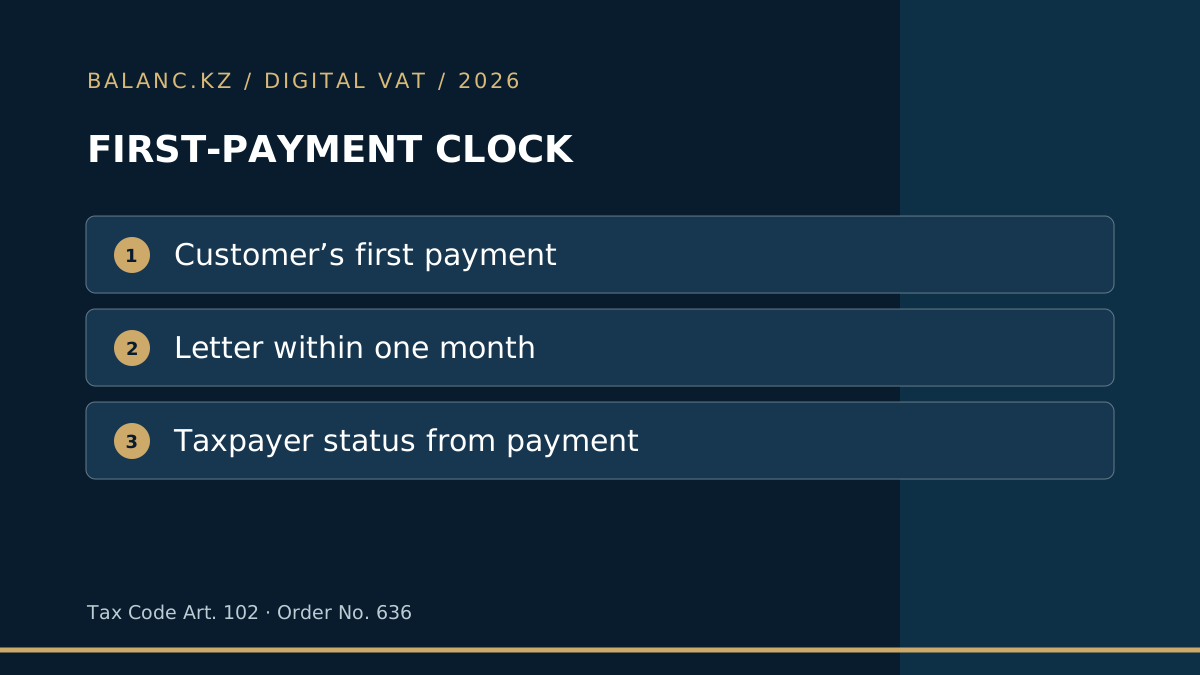
The clock starts with the first payment, not register publication
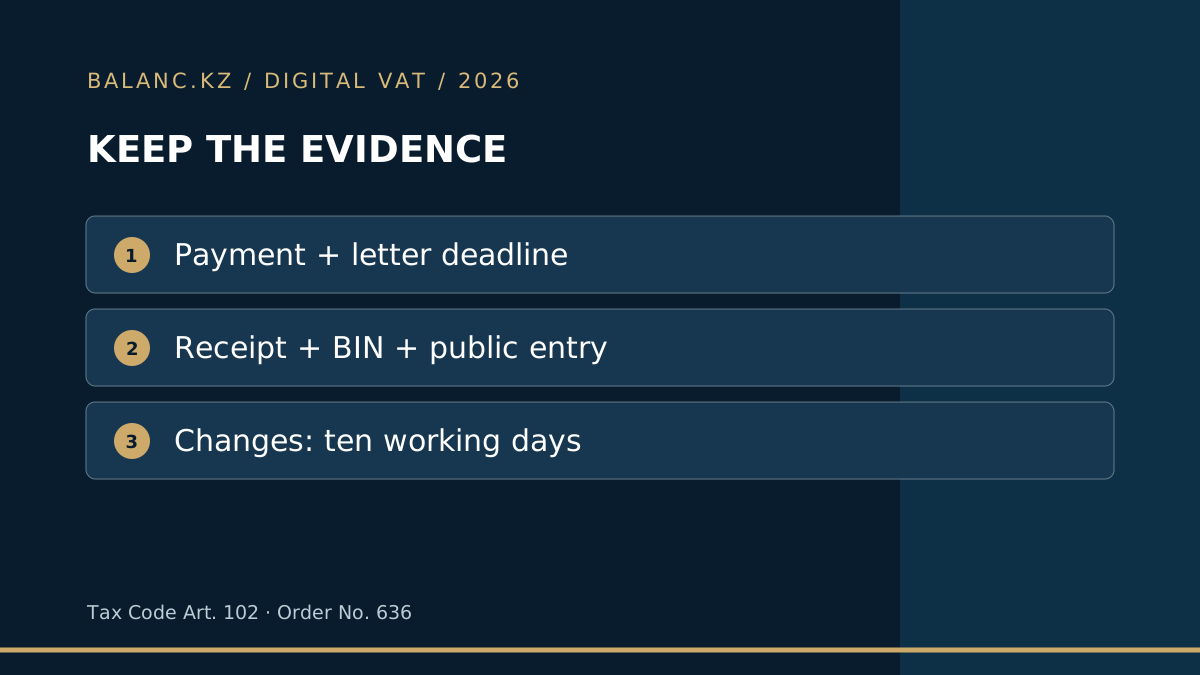
Article 102(3) and paragraph 5 of Order No. 636 require the confirmation letter no later than one month from the buyer’s first payment for goods or services. The rule says one month, not an assumed 30 days: establish the date from payment evidence and apply the calendar. Under Article 102(4), the foreign company is recognised as a taxpayer from the first payment date. A later BIN assignment therefore does not move that date or make processing time a filing extension. Retain the payment event, order ID, contractual buyer and transaction date.
With multiple platforms, check whether the first relevant payment predates the event noticed by finance. A refund or payment-provider change may require a careful factual review; do not rewrite the historic date without records. Registration and VAT calculation are related but separate obligations.
Submit the letter through ISNA with its attachments
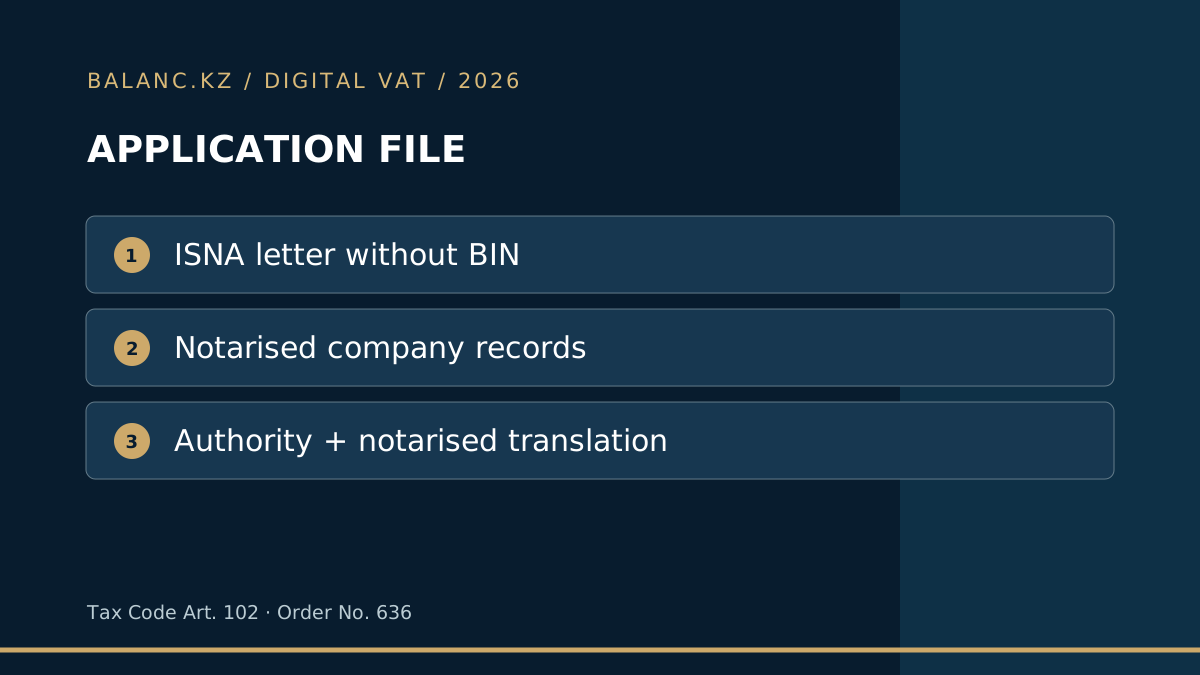
Paragraph 4 of the Rules requires a confirmation letter in the form of Annex 1 through the integrated tax administration system. The letter contains register information from paragraph 3 other than the BIN: company name, registration numbers, legal address, activity, site, email, bank details for VAT payment and receipt of sales proceeds, director and representative details, merchant ID, merchant name and MCC. Do not invent a merchant identifier: obtain the payment model and identifiers from the acquirer. Attach notarised copies of constituent documents, evidence of state and tax registration in the country of residence, and an order or power of attorney authorising the representative. The attached documents must be translated into Kazakh or Russian with notarisation.
Annex 1 has structured fields. Map a reliable source to each field before submitting, checking company spelling, home-state registration references and address. Evidence of the signer’s authority is a separate attachment. Resolve discrepancies in merchant name with the acquirer before a public entry has to be amended.
After submission: committee, Ministry of Justice, BIN and register
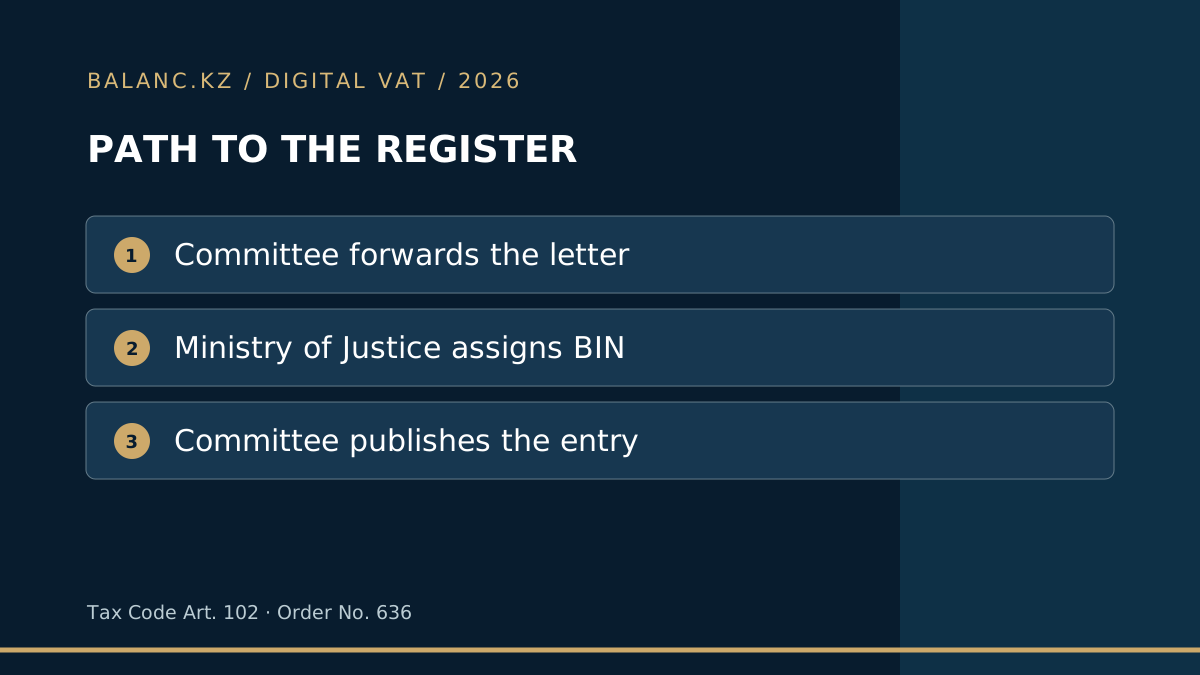
Within one working day from the day following receipt of the letter, the State Revenue Committee sends it electronically to the Ministry of Justice for a BIN. The Ministry returns electronic notice of the BIN no later than one working day from receiving the letter from the committee. The committee then publishes the company in its online register within three working days of receiving BIN notification. Once assigned, the BIN appears in the submitted ISNA letter. These are consecutive steps by different bodies, not a universal promise of “five days from filing” in every case. Keep the filing confirmation and case ID; separately check the BIN and public listing.
The Rules prescribe inter-agency and publication steps, but the actual application status and completeness still require monitoring. Confirm publication in the register rather than inferring it from a local “sent” flag. Do not tell a client it is listed when you only have a submission receipt.
ABC Corp checklist and frequent questions
Fictional ABC Corp receives its first payment on 12 October. Its team records the date and seller, verifies the individual customer’s Kazakhstan connection, prepares notarised copies and translations, completes the letter and submits within the required month. It checks BIN assignment and publication separately. A later change to register information is a distinct procedure: Article 102 and paragraph 7 of the Rules require notification within ten working days after the change. “Can we wait for a BIN before filing?” No: the letter is filed without it. “Will an ordinary translation suffice?” Paragraph 4 requires notarised translations for the attachments. “Does an empty register mean no duty yet?” No: Article 102(4) points to the first payment.
Maintain one control record: first payment; letter deadline; form version; attachments and translations; representative’s authority; submission ID; BIN; public register URL; and next verification date. Finance, legal and technical teams can then refer to the same evidenced status.
Sources
- Kazakhstan Tax Code No. 214-VIII, Articles 102 and 826 (official Russian text).
- Finance Ministry Order No. 636 of 28 October 2025, paragraphs 3–7 and Annex 1 (Russian text).
Reviewed 16 October 2026. ABC Corp is fictional; dates and attachments must be checked against the actual company records.