
A foreign digital supplier may sell the same service directly, through an agency-style marketplace or through a Merchant of Record. The checkout can look similar while the legal supply chain differs. This guide tests who sells each transaction and what evidence supports a Kazakhstan VAT conclusion in 2026.
The Tax Code concerns the foreign company making the supply
Article 3(11) describes a foreign company operating through an online platform in Kazakhstan as a non-resident legal entity selling goods or supplying services through the platform. Article 8(4) includes a marketplace that enables other persons to sell, accept orders and receive payments. A platform’s presence therefore does not by itself identify the supplier. For qualifying sales to individuals, Article 826 sets out the special VAT regime for a foreign company registered under Article 102. Merchant of Record is a commercial label; those provisions do not name it as a separate statutory VAT category.
Article 826 also requires an individual buyer and at least one Kazakhstan connection listed in its paragraph 2. A corporate contract takes a different route. This guide does not allocate every platform’s worldwide duties; it examines the actual supply chain under Kazakhstan law.
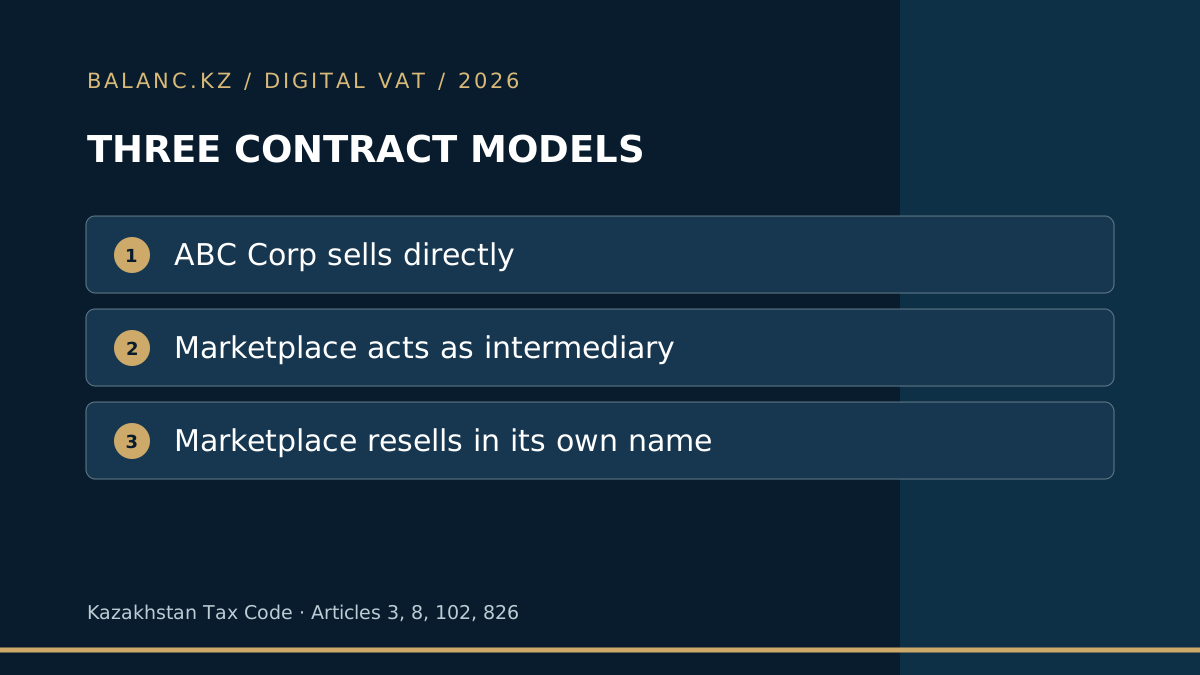
Direct seller, intermediary and contractual reseller
In a direct sale, ABC Corp contracts with the customer, supplies the subscription and collects payment. In an intermediary arrangement, the marketplace may provide a storefront, arrange orders or collect funds for ABC Corp while ABC Corp remains the contractual seller. Under a model called Merchant of Record, the marketplace may contract with the customer in its own name, set sale terms and handle refunds, with ABC Corp separately supplying the marketplace. These are hypotheses to test, not automatic VAT assignments. Channels carrying the same product can have different sellers.
Check whether X changed its role between periods. Updated terms or a new payment product can alter the contractual arrangement without changing the marketplace brand. The same logo at checkout is not a stable legal model.
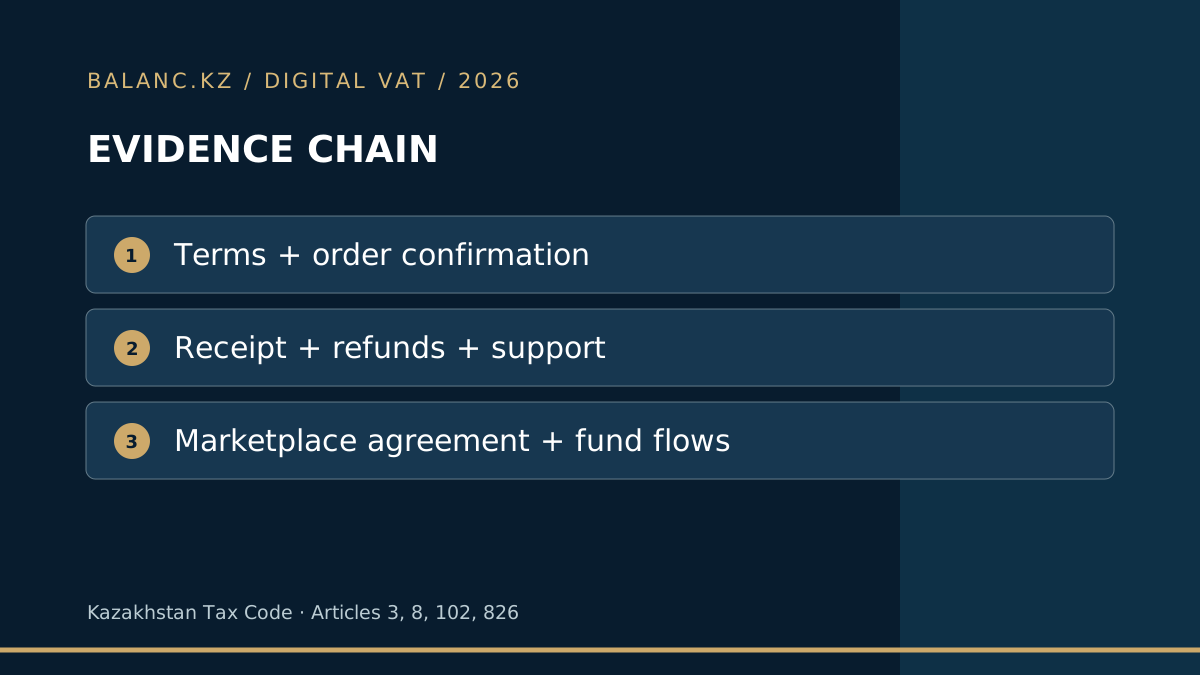
Four sets of evidence to reconcile
Read the marketplace agreement, consumer terms and order conditions in force on the payment date: who is the sale counterparty and who must provide access? Compare receipts, invoices, checkout and confirmation emails: whose legal details are shown, who takes customer claims and who issues the sale document? Review refunds and support: who decides a refund and bears the customer-facing risk? Finally trace the accounting and funds: is the marketplace withholding a commission from the seller’s revenue, or purchasing the product and reselling in its own name? A payment statement on its own cannot prove a resale.
A receipt naming X while the terms name ABC Corp is a conflict requiring investigation, not a ready answer. Review authority to act for ABC Corp, representation clauses and the real refund process. The written conclusion should explain the discrepancy.
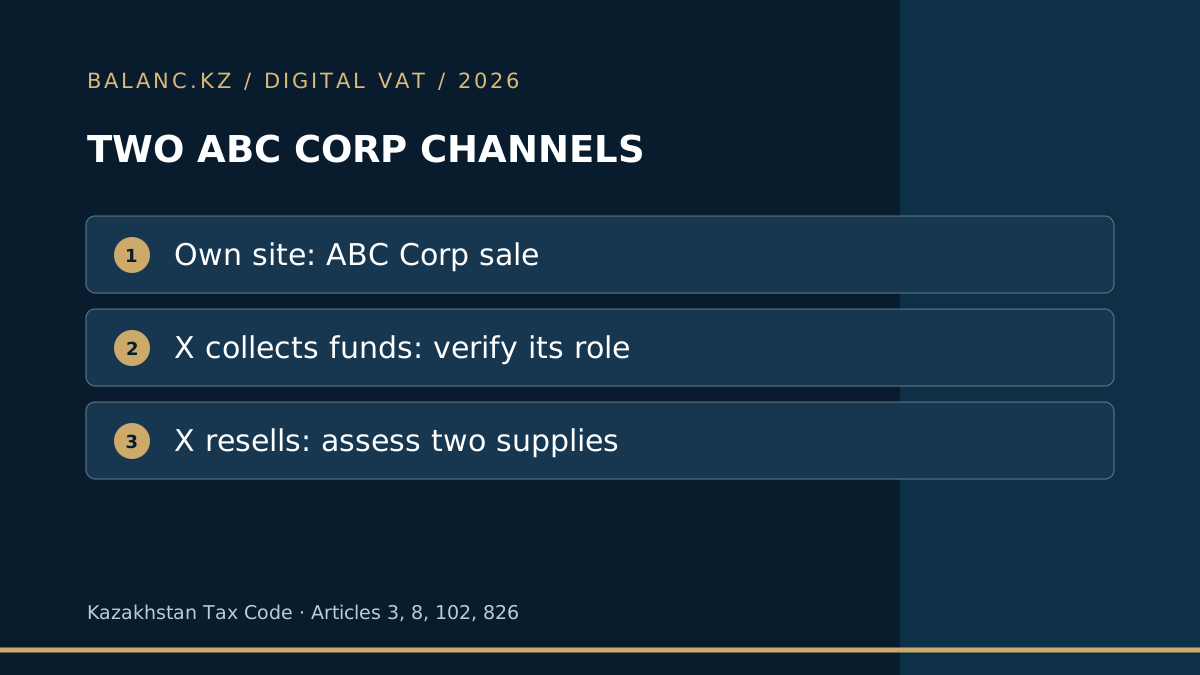
One ABC Corp subscription through two channels
On its own website, ABC Corp is named as seller in the terms and order confirmation; the customer buys a personal subscription. ABC Corp tests registration under Article 102, the customer connection under Article 826(2), calculation under Article 827 and any applicable exceptions. On marketplace X, payment first reaches X. If X only collects on ABC Corp’s behalf, receipt of funds by X does not resolve ABC Corp’s VAT obligation. If X is genuinely the customer’s contractual seller and ABC Corp makes a separate supply to X, assess both transactions: X’s consumer sale and ABC Corp’s relationship with X. The latter may involve different place-of-supply and buyer rules; do not automatically include it in ABC Corp’s consumer VAT register.
For illustration, a customer pays 100 units and the platform remits 85 after retaining 15. These amounts alone do not reveal whether ABC Corp earned 100 and paid a 15 commission, or sold separately to the marketplace for 85. Examine transfer of rights, fees, transaction records and the obligation to the customer.
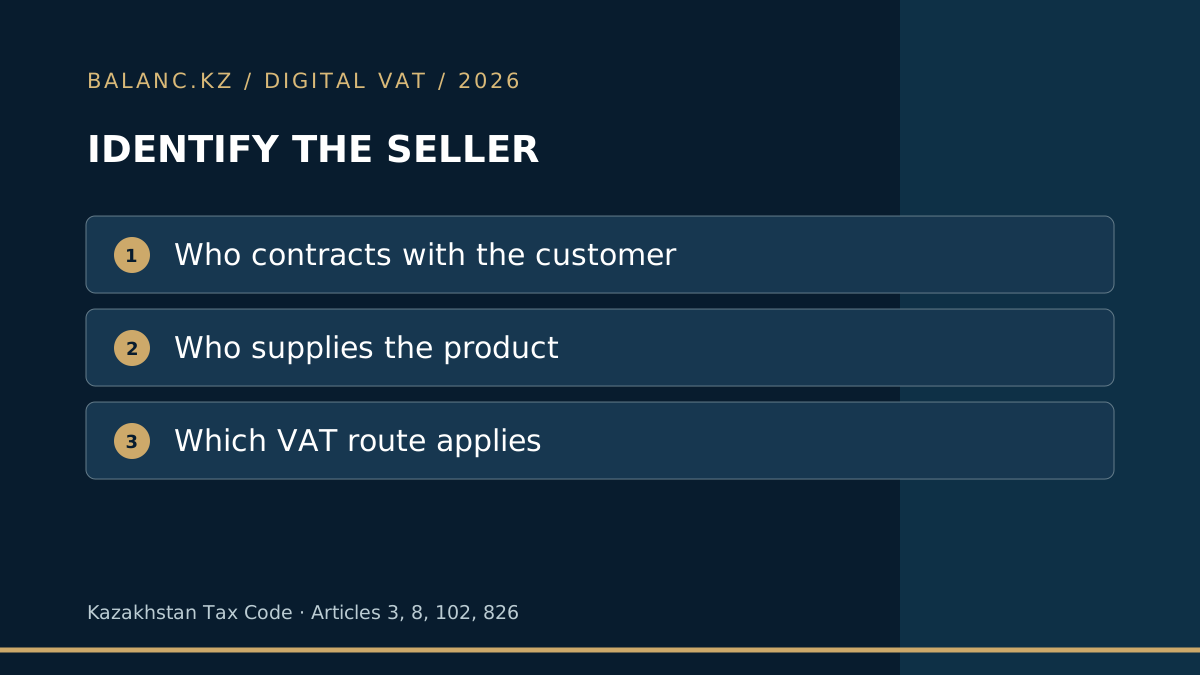
Close the seller question before calculating VAT
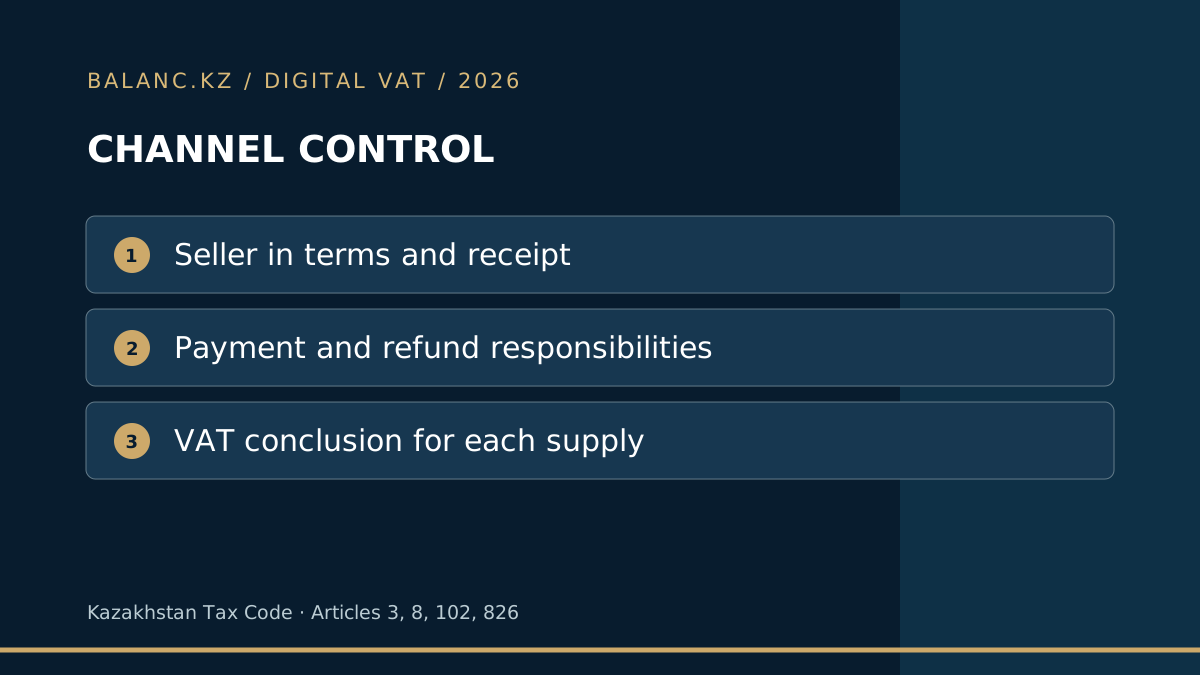
Maintain a channel matrix: seller in terms, party on the receipt, fund recipient, refund responsibility, contractual supply, buyer status and available customer-location signals. Send discrepancies to legal review, retaining historic terms and sample transactions. “Tax collected by platform” does not itself prove Kazakhstan VAT payment or discharge another party. Check the foreign-company register and the scope of the actual consumer sale. Avoid counting one consumer transaction twice without analysing the chain, and avoid removing it solely because the platform withheld tax in another jurisdiction.
Question: “The platform withheld VAT; is that enough?” Identify the country, tax, person on whose behalf it was charged and specific sale first. Question: “Does the payment beneficiary decide?” It is evidence, not final proof. Question: “Is every MoR the taxpayer?” The label alone creates no such rule.
Sources
- Tax Code No. 214-VIII: Articles 3(11), 8(4), 102, 826 and 827; official Russian text amended 1 July 2026.
- Finance Ministry Order No. 636 on foreign-company conditional registration (Russian text).
Reviewed 16 October 2026. ABC Corp and X are fictional; a real platform requires its contracts and transaction records.